19 of 50: Garton Ash maps Europe's shifting borders
The Irish Times critic notes a slim volume that overlooks Brexit and Ireland while tracing the continent's modern identity.
By Emily Brooks ·
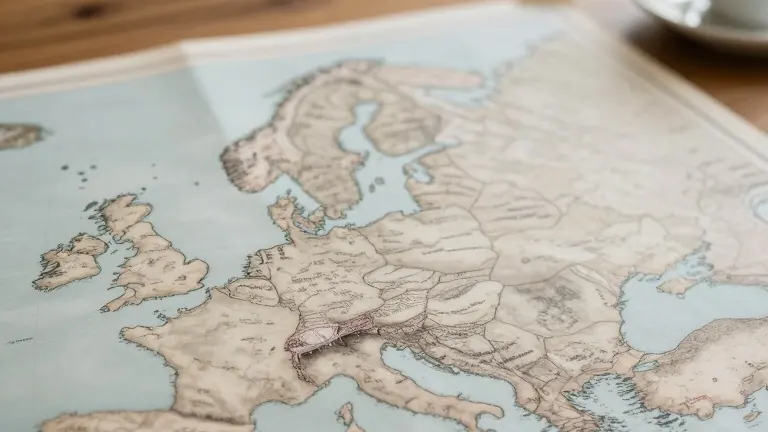
Nineteen of the 50 current countries in Europe did not exist on a 1975 map, a statistic Timothy Garton Ash uses to illustrate the continent's rapid political turnover. Ash, an emeritus professor of European studies, presents this finding in his new book, a slim volume that spans roughly 100 fewer pages than James Hawes' recent 267-page Irish history. The Irish Times critic Pat Carty reviews the work, describing it as an introduction to Europe rather than a traditional history.
Ash argues that the European consciousness emerged from specific historical pressures. He identifies the expansion of Islam as a primary driver for Christianity becoming inextricably intertwined with the continent. Ash points to a chronicle of the Battle of Tours around AD 732 as the first mention of Europeans. He also links the Enlightenment, which he calls the first great age of the coffee house, to the development of a shared identity.
Two explosive moments define the modern map, according to Ash. The first is the 1919 Versailles peace conference, where leaders like Woodrow Wilson drew lines on large maps. The second is the disintegration of the Soviet Union. These events created the current Europe of states. Carty notes that Ash contrasts Kant's elusive ideal of creative conflict without war with Orson Welles's speech about the Borgias and the Swiss in the film The Third Man.
The book includes profiles of individuals who shaped history. Ash highlights Georg Elser, the carpenter who attempted to kill Hitler in 1939. He also details the story of Natalya Taranushenko, a Russian schoolteacher who fled the state after students reported her. Taranushenko told her class that their country was behaving like Nazi Germany in Ukraine.
Carty finds the treatment of the British Isles surprising. He notes that Brexit receives scant reference and that Ireland is hardly mentioned. Carty argues that Ireland belongs in the culture chapter and shares a history of austerity with the Greeks and Spanish, whose misery Ash does point out.
The book ends by weighing two views of the continent's future. One perspective is optimistic, seeing linked and independent nations. The other is pessimistic, describing Europe as a cross between an open-air museum and an old people's home. Ash is unsure if Europe will find the sweet spot where unity and diversity are best combined in a post-West world.
Carty suggests the volume could serve as a study guide for an exam, though he believes Ash would have benefited from more room to maneuver.
More Culture · Dublin news · Report a business · Got a Story?