Dublin Crowd Challenges Irish Neutrality Bill
Thousands gathered in Dublin to oppose the government's plan to remove UN approval from the rules governing military deployments.
By Nadia Khalil ·
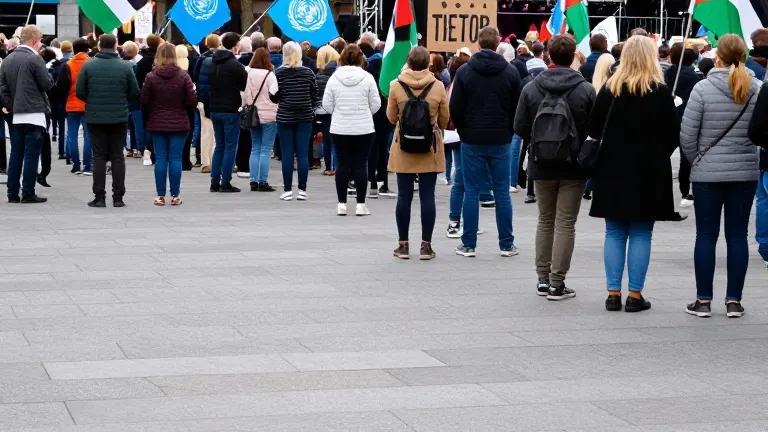
Thousands of protesters gathered in Dublin on Saturday to oppose the Irish government's plan to reform the rules governing the deployment of troops abroad. The crowd, which included supporters waving Irish Tricolours alongside United Nations and Palestinian flags, targeted the proposed changes to the triple lock system.
The demonstration marked a sharp increase in public pressure on the government, which aims to have the new legislation enacted by the end of the year. The bill would remove the requirement for United Nations approval before the Irish Defence Forces deploy more than 12 members overseas. Currently, the triple lock requires UN approval, a government decision, and a vote in the Dáil for such deployments.
Senator Frances Black performed a song titled Legal Illegal for the crowd, describing it as being about the difference between what is legal and what is right. Other demonstrators held signs with messages such as Make Tea Not War. The protest took place against the backdrop of a narrow Dáil vote last month that approved the reform of the peacekeeping troop deployment system.
Senator Tom Clonan, a former peacekeeper who commanded troops in southern Lebanon, addressed the crowd regarding the government's rationale for the change. He argued that the government was not merely reforming the system but eliminating it entirely against the will of the people. Clonan rejected the claim that the triple lock is unrelated to Irish neutrality, comparing the mechanism to the brakes on a car.
Clonan stated that the government was relying on talking points he described as disinformation. He specifically challenged the argument that removing the UN mandate would reclaim Irish sovereignty from foreign powers like Russia and China. He noted that major world leaders do not currently decide where Ireland sends its troops. Instead, he said, the binding nature of the system was a sovereign decision by the Irish people through the Oireachtas.
People Before Profit TD Richard Boyd Barrett spoke to the crowd, characterizing the government's actions as a sale of Irish neutrality under the feet of the people. He described the move as a betrayal of the country's tradition of opposing colonialism and militarism. Boyd Barrett emphasized that neutrality remains central to Ireland's identity.
Attendee Adam Stoneman told reporters that the removal of the mechanism poses a dangerous threat to Irish neutrality. He expressed pride in the country's position and its focus on diplomacy over aggressive war-making. Stoneman said he attended the protest to make a stand for the status quo that has served the nation well.
Sinn Féin TD Donnchadh Ó Laoghaire joined the speakers, saying that Irish people value neutrality and want to keep it. He argued that because the public clearly supports the current system, a referendum should be held if the government intends to remove the triple lock. Ó Laoghaire maintained that Ireland's greatest strength lies in its voice for peace and diplomacy, with neutrality as an essential component of that role.
The government has previously argued that opponents of the reform are spreading misinformation. Minister for Defence Helen McEntee stated that supporters of a referendum are being misled, noting that a referendum is typically used to amend or remove parts of the Constitution. The bill currently seeks to prevent any of the five permanent members of the Security Council from exercising a veto against Irish peacekeeping missions.
Opposition parties continue to argue that the reform will damage Ireland's commitment to neutrality. The government maintains that the changes are necessary to ensure operational flexibility for Irish troops. The debate over the triple lock and the country's neutral status remains a central issue in the Dáil as the year draws to a close.
More Politics · Dublin news · Report a business · Got a Story?