Warsaw riot police confront protesters after constitutional court leadership suspended
President Karol Nawrocki returned from Senegal to intervene as judges voted to suspend President Bogdan Swieczkowski.
By James Anderson ·
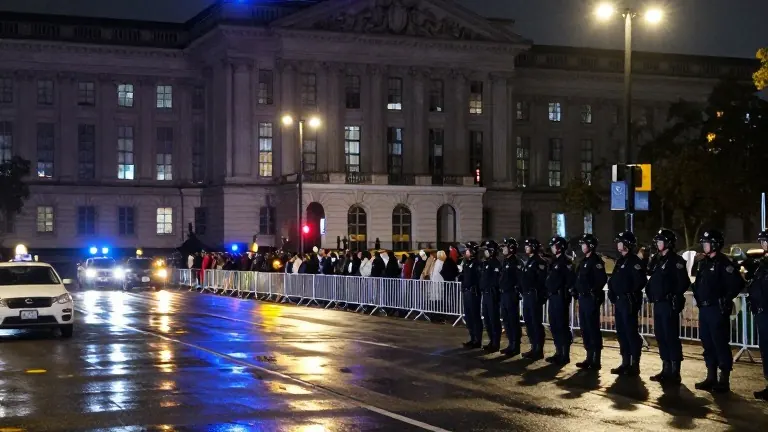
Riot police locked in a tense standoff with protesters outside the Polish constitutional court in Warsaw on Friday night. The confrontation followed a decision by a group of government-appointed judges to suspend the court’s president, Bogdan Swieczkowski, and his deputy, Bartlomiej Sochanski.
The move escalated a decade-long dispute over the legal status of Poland’s top court. Swieczkowski and Sochanski were suspended amid disagreements regarding the legitimacy of the bench. The suspension triggered an immediate reaction from the rightwing opposition Law and Justice (PiS) party. PiS leader Jaroslaw Kaczynski described the action as an assault on the court.
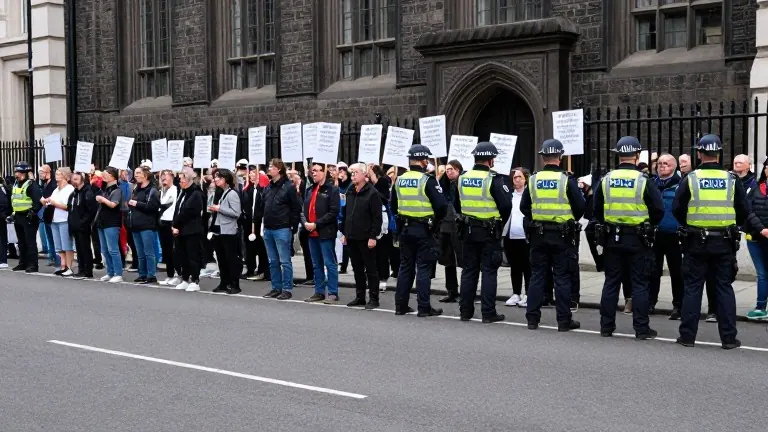
President Karol Nawrocki, a conservative aligned with PiS, was en route to Senegal for a state visit when he learned of the suspension. He turned his plane around to return to Warsaw and intervene. Hundreds of protesters, including opposition members of parliament, gathered outside the building to support the suspended judges. Police reported detaining three individuals after some protesters breached the tribunal’s fence and threw objects at officers.
Shortly before 1:00 a.m. on Saturday, Nawrocki appeared outside the court. Video footage showed the president pushing through a police cordon, tussling with security personnel and other judges to force entry. He remained inside the building as of 4:00 a.m. local time. In a clip posted online, Nawrocki stated that the government appointees who made the decision were not judges of the constitutional court.
A statement read out on Nawrocki’s behalf at 5:00 a.m. criticized the suspension as a violation of Poland’s constitutional order. The statement claimed that a constitutional body was seized by force. Nawrocki called for security forces to leave the premises.
The current conflict stems from events dating to 2015, when outgoing centrist and incoming rightwing governments made rapid moves to appoint new judges. Those appointments paralyzed the court and led to clashes with the European Union over rule of law issues. Prime Minister Donald Tusk has sought to reverse controversial reforms since returning to power in 2023. He has refused to recognize the court’s current legitimacy while attempting to mend relations with Brussels.
Nawrocki complicated the legal situation earlier this year by refusing to swear in five judges elected by the current parliament. The Venice Commission, the Council of Europe’s advisory body on the rule of law, said this month that the president’s refusal should not prevent those judges from taking their posts. On Friday, a judge named Anna Korwin-Piotrowska, one of the five not accepted by Nawrocki, claimed the top position citing her experience in the judiciary.
Legal experts are divided on the validity of the suspension. Marcin Matczak, a prominent law expert and critic of PiS, said the legal basis for suspending Swieczkowski was non-existent. Justice Minister Waldemar Zurek asked for Swieczkowski and Sochanski to be stripped of their legal immunity to face prosecution for obstructing the court’s work.
Foreign Minister Radoslaw Sikorski told reporters at a G20 meeting in Atlanta that the tribunal was politicized under the previous government. He said the current actions aim to allow duly elected judges to make the tribunal function again. Tusk insisted that restoring the rule of law is the government’s duty, describing the process as difficult but necessary after years of what he called PiS lawlessness.
Opposition leaders and the court’s social media account labeled the events a judicial coup. European far-right figures, including Nigel Farage, Liz Truss, and Geert Wilders, condemned the move. United States ambassador to Poland Tom Rose posted that the events were very serious. He noted that both sides offer sharply different accounts of the situation, adding that thousands gathering outside the tribunal make the dangerous situation more combustible.
Polls show the populist-right has a chance to return to power in next year’s parliamentary election. The latest clash is expected to further polarize the country ahead of that vote.
More Politics · Dublin news · Report a business · Got a Story?