Cold air complicates the Buckeyes' path to the gold pants
Physiologists and a former Buckeye explain how late November temperatures affect hand dexterity and muscle function during the Michigan rivalry.
By Ethan Mitchell ·
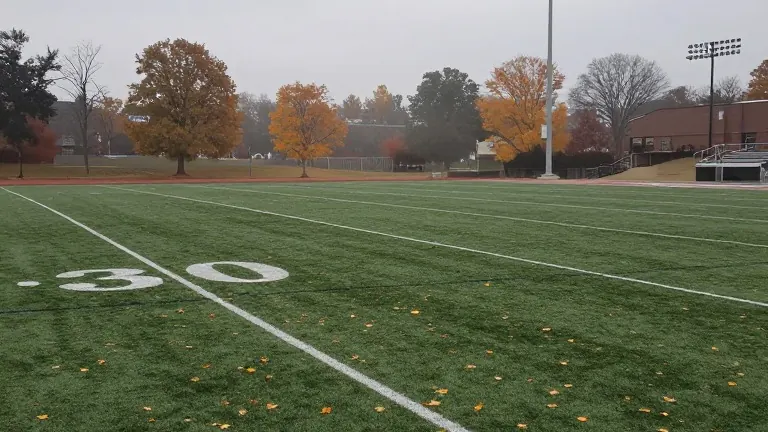
Ohio State football players face near-freezing temperatures this Saturday when they travel to Michigan for the annual rivalry game. The contest determines which team wins the gold pants, a pair of small gold trousers awarded to the victor. While the prize itself is unaffected by the weather, the athletes competing for it must contend with the cold.
Recent editions of the game have featured harsh conditions. Weather Underground data shows the 2024 matchup saw temperatures drop to 26 degrees Fahrenheit, with wind chills reaching 17 degrees. The following year, on Nov. 29, 2025, the game in Ann Arbor recorded low temperatures of 27 degrees and a chill factor of 19 degrees, with snow falling during the contest.
John Castellani, a research physiologist at the U.S. Army Research Institute of Environmental Medicine, explained that the human body reacts to cold by trying to preserve its internal heat. The first physiological response is vasoconstriction, where blood vessels near the skin narrow. This process reduces warm blood flow to exposed areas like the hands, fingers, and face. By limiting surface blood flow, the body protects vital organs from heat loss.
Castellani noted that this conservation strategy has a cost for athletes. When hand temperature drops below 60 degrees Fahrenheit, hand movement begins to decline. For football players, reduced dexterity makes gripping, catching, and throwing the ball more difficult. This is why quarterbacks and other players often wear gloves and use hand warmers during cold-weather games.
Bobby Carpenter, a former Ohio State linebacker who won the 2002 national championship and was selected in the first round of the 2006 NFL Draft, confirmed these effects. Carpenter said that areas where circulation is lost quickly become difficult to manage. He recommended wearing medical gloves underneath standard athletic gloves to create an insulating layer that retains heat.
As exposure to the cold continues, the body initiates shivering to generate warmth through involuntary muscle contractions. Castellani stated that muscle contractions lose effectiveness when muscle temperature drops approximately three to four degrees below normal. Since human muscle temperature is close to body temperature, or about 98.6 degrees Fahrenheit, a drop of a few degrees impairs muscle function.
However, football players generate significant heat through physical exertion. Castellani explained that active players typically do not cool off as much as sedentary individuals, even when they step onto the sidelines. Carpenter agreed, noting that active play keeps circulation moving. The challenge arises when players sweat during activity and then become inactive on the sideline, where wind and low temperatures make it harder to stay warm.
Castellani said insulated jackets and heated benches help players maintain warmth between plays. He also noted that players who practice in cold conditions can habituate to the environment over time. This adaptation makes late November weather feel less uncomfortable for athletes accustomed to such conditions compared to those from warmer climates.
Despite this habituation, Castellani emphasized that comfort does not guarantee better performance. The impact of cold depends on activity level, clothing, and individual physiological responses. For Ohio State, the cold remains a factor in the 60 minutes required to defeat Michigan and claim the gold pants.
More Sports · Columbus news · Report a business · Got a Story?