Israeli Election Results Signal Hung Parliament, Setting Stage for Coalition Talks
Final counts confirm a split legislature, forcing leaders to negotiate alliances between Jewish and Arab parties or risk a new vote.
By Emily Brooks ·
Final election results in Israel are expected to confirm a hung parliament, with no single bloc holding the majority needed to govern. Local media projections indicate that Binyamin Netanyahu’s coalition partners will secure 53 seats in the 120-seat Knesset. Opposition parties are projected to hold 48 seats, while Arab-led parties, which also sought to replace Netanyahu, are expected to win 19 seats.
The outcome leaves the country without a clear path to government, requiring leaders to form alliances to reach the 61-seat threshold. These negotiations will determine whether Jewish and Arab parties form a historic alliance or if parties that campaigned against Netanyahu will join forces with the prime minister. Netanyahu remains in charge as the final tally is processed.
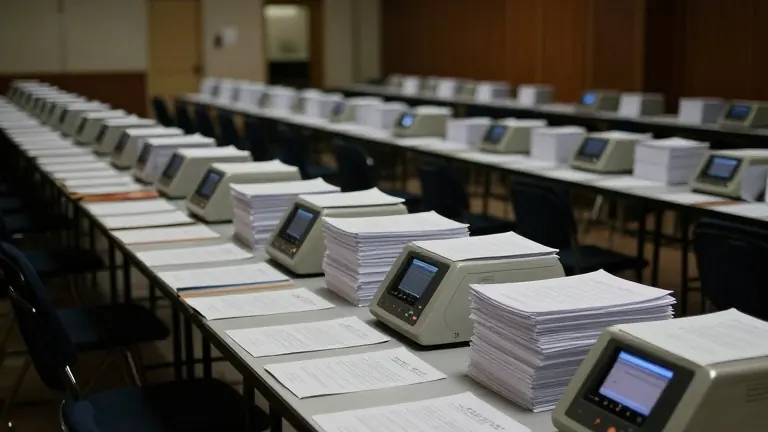
About half a million absentee ballots are being counted, including those from military personnel, diplomats, and individuals in prisons and hospitals. Analysts do not expect these votes to dramatically sway the overall result. The final numbers could be available as early as Thursday evening.
Gadi Eisenkot, the chief rival to Netanyahu and former military chief, addressed supporters early Wednesday. In his first public statement since the address, he spoke of a government that serves all citizens and reflects the popular will. Eisenkot did not explicitly mention joining forces with the Arab-led parties, which had a strong showing in this election. However, he has previously stated he is open to working with them to secure a majority.
The Joint List, one of the Arab-led parties, noted the "unprecedented show of strength" in its results. The party also acknowledged Jewish voters who supported the alliance, describing them as willing to swim against the tide of racism. The Joint List said it remains open to political cooperation. Small rallies were held overnight in Tel Aviv and Jerusalem to support a coalition that includes Arab-led parties. Until 2021, no Arab party had joined a coalition government, and that arrangement was brief.
Netanyahu’s Likud party, which received the most votes, has accused Arab-led parties of stealing the election. The party asked the election committee to investigate these claims but did not provide specific evidence. The election committee stated that the number of reported irregularities was low in the relatively calm election.
Israel’s President Yitzhak Hertzog will task an individual with forming the next government next week. Traditionally, this role goes to the leader of the party with the most votes, but it is not a requirement. If a new government cannot be formed after multiple attempts, Israel will face a new election early next year. Hertzog signaled on Wednesday that he wants to avoid a repeat vote, a sentiment shared by Eisenkot.
New elections would raise questions about voter turnout, particularly among Arab citizens and the tens of thousands of Israelis who flew home to vote. Many of those overseas voters said they traveled to save the country from Netanyahu. The country entered this election divided along religious, secular, and ethnic lines, with major issues at stake, including military service exemptions for the ultra-Orthodox population.
Brosli Elias, a resident of Nazareth, one of Israel’s largest Arab cities, expressed cautious hope for change. He stated, "God willing, we will have something for us in the government, something that will bring us our rights." The threat of further strikes against Iran adds to the uncertainty, as the Trump administration has spoken of new attacks after the midterm elections on November 3.
Experts suggest Netanyahu could use a renewed war to press for a unity government with him in charge. This strategy could delay a public inquiry into the security failures that led to the Hamas-led assault on October 7, 2023. That attack remains the deadliest in Israel’s history and sparked the war in Gaza.