
Breaking: Democrats' data center push triggers Wall Street's worst day since April
A political shift against AI infrastructure wiped out trillions in market value, sending shockwaves through retirement accounts and local portfolios.
By Emily Brooks ·
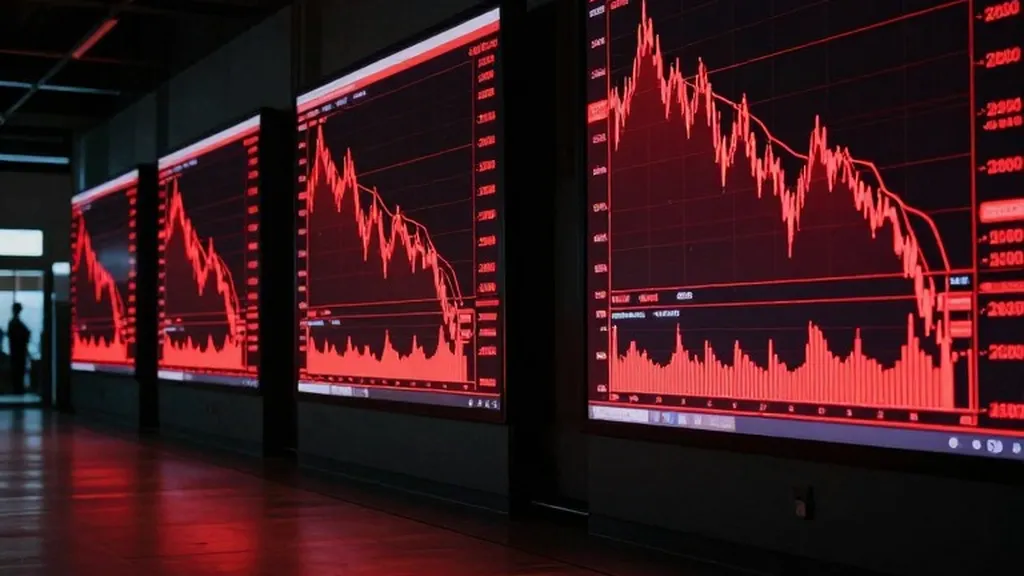
The stock market experienced its most turbulent day in months on Thursday, driven by a sweeping political victory for Democrats who campaigned on slowing the expansion of artificial intelligence infrastructure. The Dow Jones Industrial Average, which tracks thirty large US companies, fell more than 1,800 points, a drop of 3.4 percent, to close at 51,868. This sharp decline erased all the gains investors had made on Wednesday, marking a dramatic reversal in sentiment. The S&P 500 dropped 4.3 percent, its worst performance since April 2025, while the Nasdaq Composite fell 5.5 percent, its steepest drop in eighteen months. An estimated $2.5 trillion in market value was wiped from the Nasdaq Composite in a single session.
The primary catalyst for the crash was the Democrats' complete sweep of both the House and Senate in Tuesday's midterm elections. Across the country, Democratic candidates ran on platforms that emphasized slowing the spread of data centers and regulating the rapid growth of AI. Dozens of ballot measures aimed at restricting data center development were placed on the voting rolls, and voters rejected these facilities in a series of local ballots. This coordinated political movement signaled a potential shift in how states will approve and regulate the massive facilities that power the AI build-out.
In Texas, Democrat Gina Hinojosa won the race for governor after campaigning on an immediate moratorium on new data center construction. Her victory, along with Democratic wins in other states with large concentrations of planned data centers, including Ohio, heightened investor concerns. These victories suggest the facilities at the heart of the AI build-out will face new hurdles. Investors began weighing whether tighter state-level restrictions could slow data center construction, thereby pressuring companies tied to the artificial intelligence trade. This political development compounded existing fears that the huge sums being spent on AI may not pay off and that AI shares could be in a bubble.
The selling was led by technology and chip stocks, which had been major drivers of recent market gains. Nvidia, a key component of the Dow, fell 9.2 percent, losing more than $400 billion in market value. Other major tech firms also suffered significant losses, with Tesla dropping nearly 11 percent and SpaceX falling 8 percent. The Philadelphia Semiconductor Index, which tracks thirty of the largest chip companies, fell more than 12 percent. This index has fallen more than 30 percent since the beginning of October and is almost 40 percent below its peak in June. The iShares Semiconductor ETF fell 12 percent, marking its worst day since the market breakout in March 2020.
For local readers in Columbus and across Ohio, this day represents a significant shakeout for retirement accounts and personal savings. Many individuals hold 401(k) plans or individual retirement accounts that are heavily invested in broad market index funds. A drop of this magnitude means that the value of these portfolios decreased sharply over a single trading day. While markets often recover from such events, the speed and breadth of the selling can cause anxiety for savers and small investors who rely on these accounts for long-term financial security. The volatility highlights the interconnectedness of national politics and local financial stability, even for those not directly involved in the tech industry.
Market strategists are divided on the immediate outlook. Neil Wilson, an investor strategist at Saxo UK, described the event as a complete capitulation-level event in tech stocks. He noted that the fear is a total momentum unwind as Democrats pace the frontier and kibosh data center buildout. Wilson added that while the move looks overdone, the nature of the market means investors need to look for stability first. Dan Ives, a tech analyst, stated that there is no way to sugarcoat the fact that Democrats taking control will create major hurdles for AI and tech legislation in the Beltway over the next two years. He viewed the midterm results as a clear sign that the pace of data center build-out will start to slow.
Other analysts offered more nuanced perspectives on the long-term trajectory. Ted Parkhill, founder of Incline Investment Management, said the market is moving from the promise of AI to the price of AI. He emphasized that while AI is transformative in the long run, not every AI-related stock is priced appropriately, and there will be turmoil. Susannah Streeter, chief investment strategist at Wealth Club, noted that fresh panic over the AI trade has hit Wall Street hard. She explained that fears that vast sums poured into AI infrastructure may not deliver returns are colliding with the prospect of a sharp slowdown in data center construction. Gene Goldman, chief investment officer at Cetera Financial Group, predicted a recovery, stating that corrections in a bull market are typically short-lived and that a bounce back is expected soon.
Historically, markets have recovered from similar political shifts, though the path can be volatile. Frank Cappelleri, founder of CappThesis, noted that the Nasdaq was higher twelve months after the election in all but one of thirteen midterm cycles since 1974. However, he cautioned that the path can be a volatile one. A review of ten Nasdaq corrections over the last decade found that while some were followed by further rough selling, the Nasdaq was back in rally mode six months later in every case except 2022. On average, the Nasdaq gained 9.41 percent in the three months after a correction bottom and 17.03 percent over six months. This historical data provides a context for understanding that while the current drop is severe, it may not be the final destination for the market.
More Business · Customer Complaints · Report a business · Got a Story?