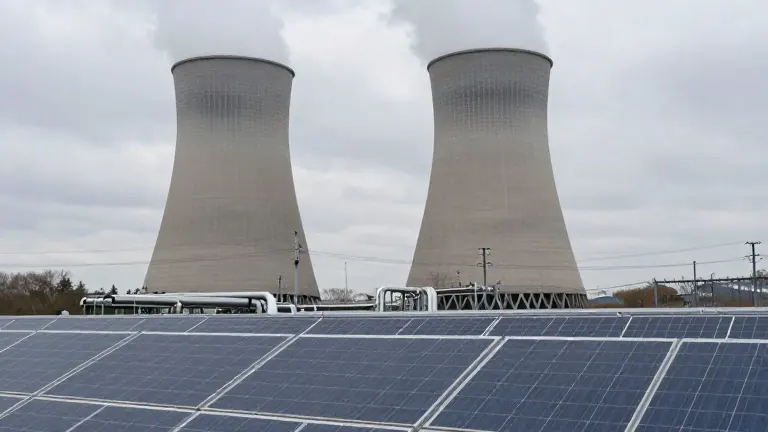
Virginia staff advise commissioners to reject $67 billion Dominion-NextEra merger
Regulators cited unproven public benefit and potential price hikes in their recommendation to the State Corporation Commission.
By Nadia Khalil ·
Virginia residents may soon face a decision on whether a massive utility merger proceeds, after state regulators recommended rejecting the deal on Monday. Staff at the State Corporation Commission concluded that Dominion Energy and NextEra Energy have not proven the transaction serves the public interest. The staff also warned the combined entity could lead to higher electricity prices for consumers.
The recommendation targets a $67 billion combination of the two utilities. PJM's independent watchdog, Monitoring Analytics, joined the push for rejection. The group asked federal regulators to block the merger, arguing it would grant NextEra an unprecedented amount of economic and political power. Monitoring Analytics also claimed the deal would deter competition within the grid.
Governor Abigail Spanberger entered the debate by advising commissioners to reject the merger unless specific conditions are met. She proposed a six-year freeze on residential rates and a tripling of monthly bill credits. The governor is also pushing to eliminate the state's current cap on rooftop solar installations.
Three commissioners must vote on the merger by January 15, 2027. If they miss that deadline, the deal is automatically approved. The outcome will shape the energy market for Virginia households and businesses in the coming years.
In other energy developments, the Solar Energy Industries Association released data showing solar and storage are cutting wholesale electricity costs in both red and blue states. From 2021 to 2026, average wholesale prices fell 42 percent in Texas and 51 percent in California. In Texas, demand surged 30 percent, yet prices dropped from about $55 per megawatt-hour to $32. In California, usage grew 2.5 percent while prices fell from $78 to $38.
Solar generation rose 421 percent in Texas and 90 percent in California over that five-year span. Battery capacity grew more than 26-fold in Texas and nearly sevenfold in California. SEIA estimates solar and storage saved Texans about $3.55 billion and Californians about $2.5 billion in the summer of 2026 compared to the summer of 2021. Despite these generation savings, total residential bills rose 3 percent in Texas and 22 percent in California due to higher transmission and distribution costs.
New Jersey Congressman Rob Menendez introduced the Socket Full of Sunshine Act to standardize plug-in solar rules. The bill requires state utility commissions to consider portable solar devices unless state legislatures have already addressed them. The bill defines these devices as up to 1,200 watts, plugging into a standard 120-volt outlet, and meeting National Electrical Code standards. It offers rebates up to $1,000 for low- and moderate-income households, funded at $100 million annually through 2032, provided the states allow tenants to use the systems and the devices contain more than 55 percent domestic content.
Source: Columbus Free Press · original report published
More Business · Columbus news · Customer Complaints · Report a business · Got a Story?